Old Torphins, Images and Stories (external site)
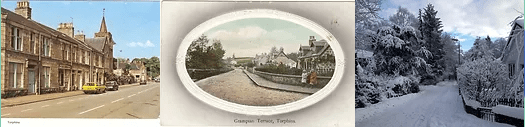
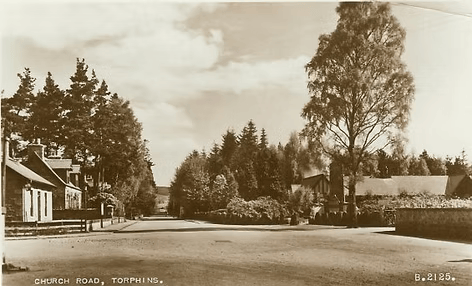
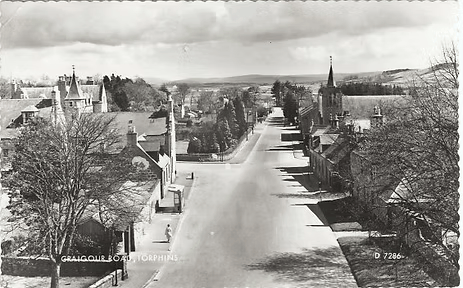
Torphins is a village in Aberdeenshire, about 23 miles west of Aberdeen, on the A980. While the area has been populated over many centuries, the village grew to prominence in the 19th century, driven by the development of the Great Northern Railway.
The village has a population of around 1500 people involved in agriculture, local trades and services, as well as commuters working in Aberdeen and surroundings. The growth of the Oil and Gas industry in Aberdeen has had a considerable but not overwhelming impact in the growth and demographics of the village.
Torphins has many amenities, including a primary school, nursery and playgroup, and a local health centre. The Learney Hall is a well used local hub for community events, as is Mid Deeside Church hall. In common with many villages , local shops have declined over recent years, but the village still boasts a busy supermarket, pharmacy, charity shop, Indian restaurant and bar, Chinese takeaway, Platform 22 café and art gallery which hosts a weekly farmers market:
(https://www.facebook.com/Platform22/) ,
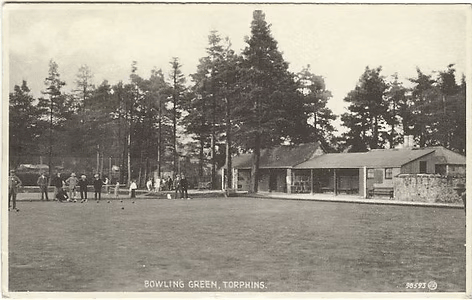
There is also a car dealership, and large residence for house party rentals. Recreation facilities include a large park, tennis courts , bowling green, curling rink and a 9 hole golf course.
The village is linked by bus service 202 to the surrounding villages through Banchory and Peterculter then to Aberdeen.
For forthcoming events see:
https://www.facebook.com/TorphinsCommunity/
Historic Postcard Gallery

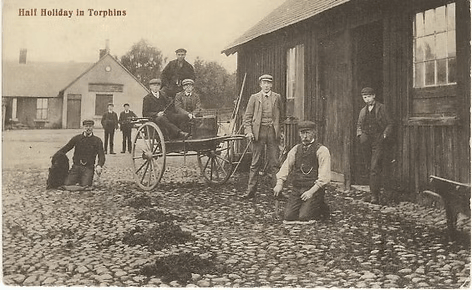
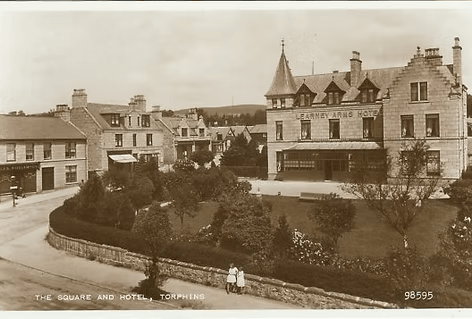
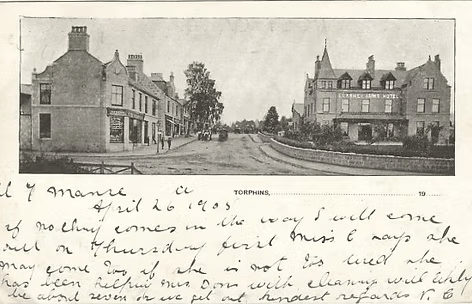
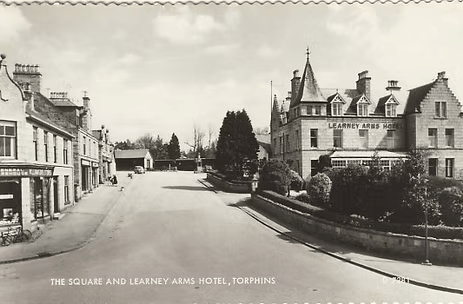
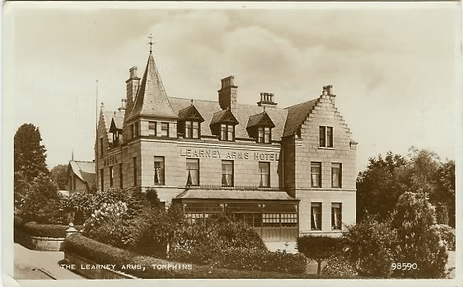
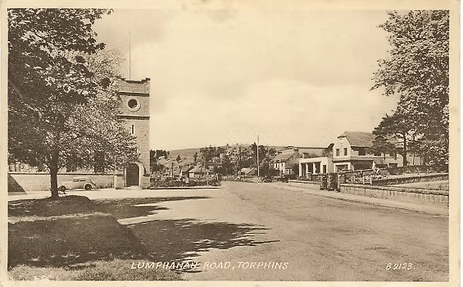
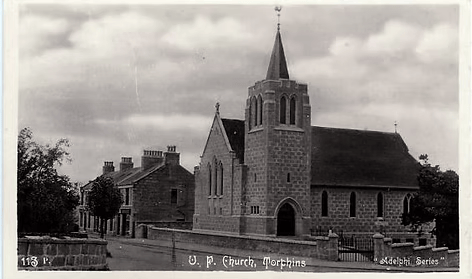
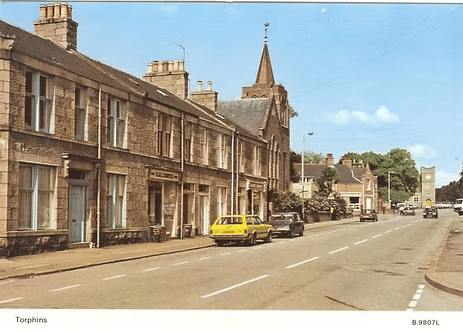

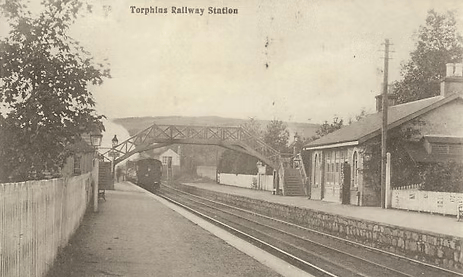
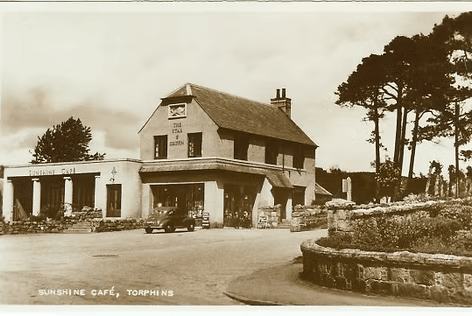

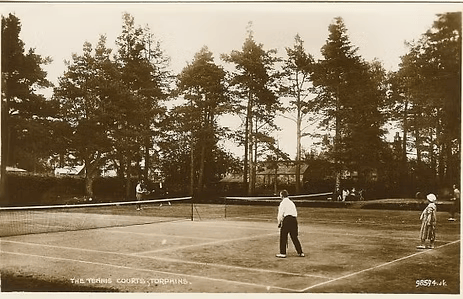
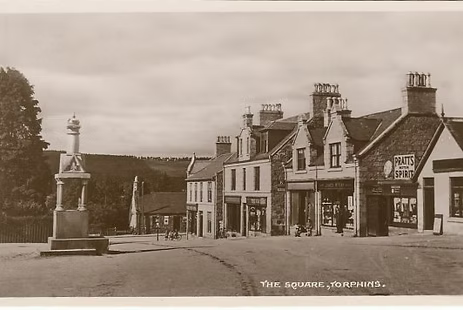
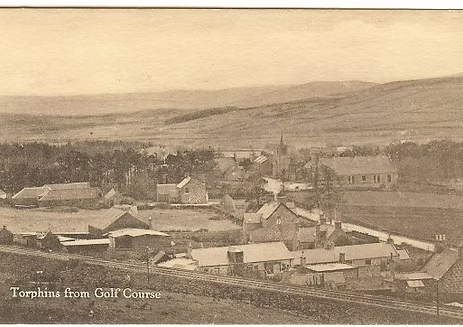
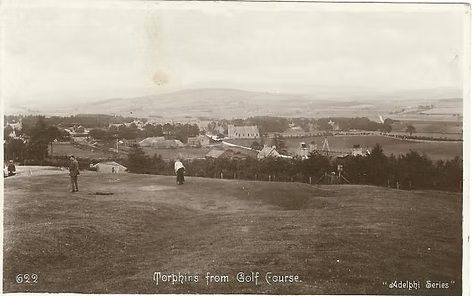
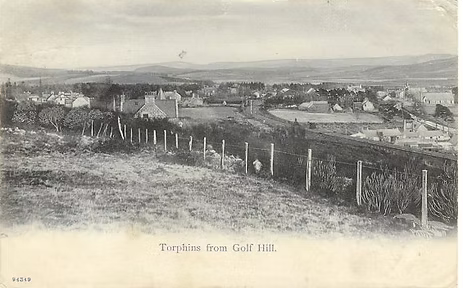
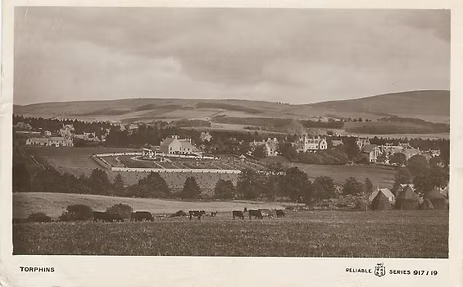
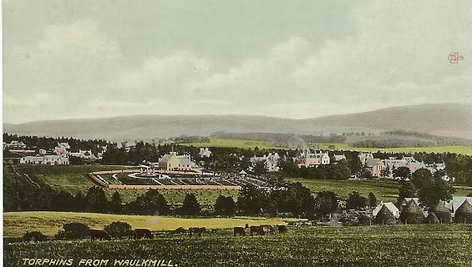

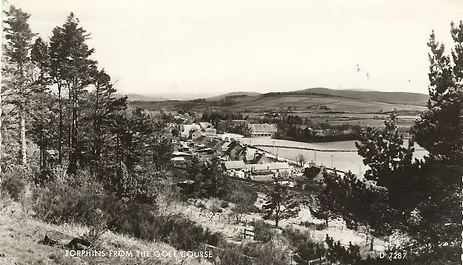
The Brebners and Torphins.
With thanks to the Brebner website.
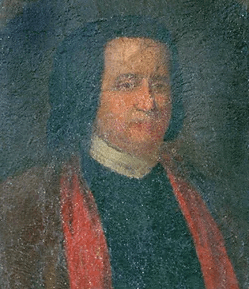
To trace the Innes estate of Learney we must first look at the Brebner family. The earliest Brebner found is John Brebner of Corskie , born in 1630. He was a merchant in Aberdeen and in 1653 he married Agnes Moi r who is believed to have been the daughter of John Moir, 1st of Stoneywood, Aberdeen. They had five sons and two daughters and to date I have only been able to trace information on the marriage of one of these children, James, born in 166 5, married in 1704 to Elizabeth Gordon, daughter of John Gordon, 2nd of Fechil.
James and Elizabeth had ten children; the one that matters for this record is William who was born in 1713. William acquired the barony of Learney and it is from here that we must look for the Innes connection.
In 1743 William Brebner married Jean Buchan, the daughter of Major James Buchan , 11th of Auchmacoy. They are said to have produced nine children but only one of the children is reported to have had children of his own, that being Alexander , born in 1753. In 1783 Alexander Brebner married Christian Leys, the daughter of Francis Leys of Glasgoforest. The wedding took place in Aberdeen, the city whe re Alexander became Lord Provost. As was the Brebner tradition, this marriage was said to have produced a large family, twelve in all, ten girls and two boys.
Neither of the two sons had any children and indeed, only three of the daughters married and had children. Daughter Frances was born in 1789 and she married Hugh Lumsden, 2nd of Pitcaple, and they had a daughter, Christina Lumsden. I presu me that Frances died after the birth of her daughter as Hugh Lumsden married for a second time and had other children but that need not worry us here. France’s younger sister, Anne was born in 1799 and in 1825, in Aberdeen, she married William Gordon-Cuming-Skene, 12th of Pitlurg, but they had no children. William Gordon-Cuming-Skene was supposedly a relative of Elizabeth Gordon, the great grand mother of his wife Anne. The third daughter of Alexander Brebner and Christian L ey to be married was the eldest one, Jean (or Jane). She was born in 1786 and in 1812 she married William Innes of Raemoir, born circa 1785. We now have a link between William Brebner of Learney and the Innes Clan through the marriage of his granddaughter Jean to William Innes of Raemoir. Jean Brebner inherited Learney estate jointly with her unmarried sister Mary on her father’s death in 1823.
William Innes and Jean Brebner had two sons, Alexander, the eldest to whom the Innes of Balvenie line descends, and Thomas. On the death of Jean in 1872, at the age of 86, the barony of Learney went to her younger son Thomas and so we now have the first Thomas Innes of Learney. Thomas had 3 sons who all predeceased him. The eldest William who was in the Royal Engineers, was killed in Malaya in 1875, William Street in Torphins is named after him. Col Francis Innes was the youngest son, died in 1907
Born in 1893, Thomas was the son of Col Francis Innes who married Lady Lucy. Thomas who was to become Sir Thomas Innes of Learney and become prominent in the Lyon Court of Scotland. He was to become a Knight Grand Cross of the Victorian Order (G CVO) and he was honoured as a Doctor of Law (LLD) and was a Fellow of the Society of Antiquaries of Scotland (FSA(Scot)). In 1928 he married Lady Buchan, daughter of the 18th Earl of Caithness. In 1945 Sir Thomas of Learney was appointed Lo rd Lyon King of Arms, the head of the Lyon Court in Scotland. a post which he held until 1969, about two years before he died. Whilst holding the office of Lord Lyon he was the author in 1965, of the revised edition of The Clans, Septs and Regiments of the Scottish Highlands by Frank Adam
A book which he wrote in 1938, The Tartans of the Clans and Families of Scotland is still regarded today as one of the finest works on tartans.<br><br>
Sir Thomas and Lady BUCHAN were married in 1928. Sir Thomas died in 1971 leaving three sons and a daughter. He was buried about 16 Oct 1971 in Kincardine O’Neil (Plot 292). He is reference number 57. The eldest son, Thomas, now Thomas Innes of Learney,BSc (Agric) OStJ., was born in 1930 and educated at the Edinburgh Academy and Edinburgh University where he obtained a BSc degree in Agriculture. He served for a time in the army in the Royal Corps of Signals. In 1958 married Rosemary Elizabeth Jackson, daughter of the late Brigadier Cecil Vivian Staveley Jackson, CIE, CBE, of Burnside Arboyne, Aberdeenshire. They have a daughter, Maureen Cecila, born in 1962. From 1971 to 1976 he was president of the Deeside Field Club.<
The second son of Sir Thomas Innes and Lady Buchan is Berowald Fortesque Innes of Inverisla. Born in 1931, he was educated at Melville College and, like many of the Innes family, is a Fellow of the Society of Antiquaries.
The third child born to Sir Thomas Innes and Lady Buchan was their daughter, Sybil Marjorie Innes, born in 1934.
The fourth offspring was a recent Lord Lyon King of Arms, Sir Malcolm Rognvald Innes of Edingight, born in 1938.
Learney Hall.
In 1899 the impressive grey-stone Learney Hall was built towards the north west end of the village, to mark the golden wedding anniversary of the local laird, Thomas Innes of Learney.
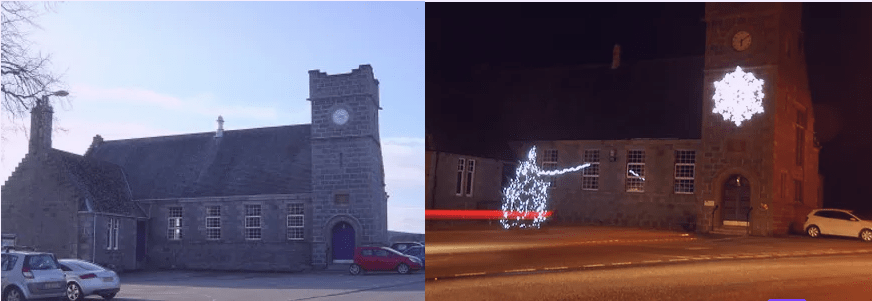
Learney Hall in Torphins is a very beautiful small Hall, owned by Aberdeenshire Council and operated by Live Life Aberdeenshire. The hall is used by many community groups and clubs for meetings, coffee mornings, sales, dances and other activities. It is also an excellent venue for ceilidhs, birthday parties, fundraisers and wedding receptions.
Contact
9 Beltie Road
Torphins
BANCHORY
AB31 4JT
Booking:
townhalls@aberdeenshire.gov.uk
or
01467 537753
Queen Victoria’s Monument.

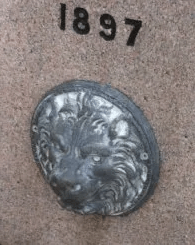
Queen Victoria’s Monument (dt. 1897), is situated in the Learney Arms car park and has been subject to cleaning and repair. The replacement decorative water outlet, in the form of a lions head (see below) was also replaced. The outlet has been replaced just in time for the Queen Elizabeth II, Diamond Jubilee Celebrations in June 2012. This restoration was possible with the help of old photographs. Thanks to all those involved in the restoration.
Walkers Shortbread.
With thanks to Walkers Shortbread.
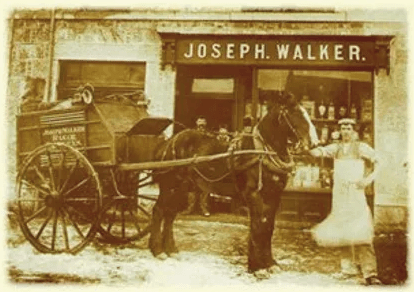
The Walkers story begins over a hundred years ago in 1898, when the twenty-one year old Joseph Walker opened the doors of his own bakery at Bridge Crescent in Torphins with a loan of £50 and the dream of making the finest shortbread in the world.
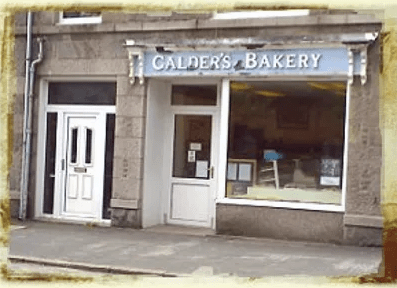
In the first year of business, Joseph used every spare moment to perfect his shortbread recipe, and it was time well spent. Soon, shooting parties from the local estates were making detours to Joseph’s bakery.
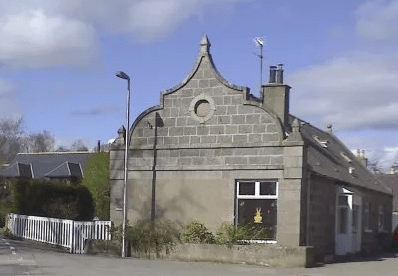
By the 1970s, Joseph’s grandchildren had begun exporting Walkers shortbread to over 60 countries around the world – still baking to his original recipe. Within a decade, they won the first of three Queen’s Awards for Export Achievement – the highest accolade given to British exporters.
Great North of Scotland Railway.
The Company was set up in the railway mania of 1845/46 to build a line from Aberdeen to Inverness. The original plans envisaged a double track line which would have cost 1.5 million pounds, quite a tidy sum in those days and way beyond the means of the people of the area to raise.
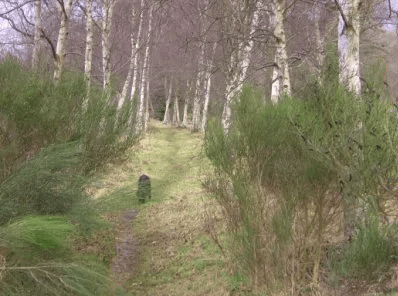
Several branches were planned at the same time to bring the advantages of railway transport to the whole area. What happened in fact was that the GNS eventually built its line as far as Keith and the rest of the route to Inverness was built by a separate company, later part of the Highland Railway, promoted by the people of Inverness and the surrounding area who would have nothing to do with the Aberdeen folk who promoted the GNSR.
Another early company operating in the area was that of the Deeside Railway, which opened to Banchory in September 1853 and was later extended on to Aboyne and then Ballater, passing through Torphins and Lumphanan in December 1853. It had originally been intended to go via Kincardine O’neil, but as the route would have required two bridges over the Dee and more land purchases, this route was abandoned. The route from Ballater to Braemar was never completed as planned after Queen Victora objected, fearing disturbance at her estate in Balmoral.
The Deeside Railway was a Royal line from the early days. Queen Victoria travelled from Banchory in 1853 and travelled by royal train until three months before she died in 1901. The last Royal train was 7:15 pm, 15th October 1965, with Queen Elizabeth travelling to Aberdeen from Ballater. It was, seemingly, a thoroughly wet & miserable evening but several hundred people turned out nevertheless to bid the Queen Elizabeth farewell.
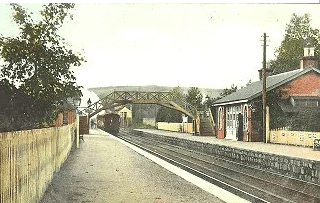
The Deeside railway ceased operations in 1966, and the station in Torphins has long disappeared. Today there is still some physical evidence of the railway remaining, including the bridges, other buttresses, as well as the name of Station Road.
Here is a link to the demolition carried out in 1989 of the Balnacraig viaduct between Torphins and Lumphanan near Sundayswells:
How not to safely demolish a viaduct!
Torphins itself contracted following the demise of the railway, but only briefly, before expanding, like so many of Aberdeenshire’s settlements, following the beginning of the North Sea oil boom in the 1970s.
Royal Deeside Railway
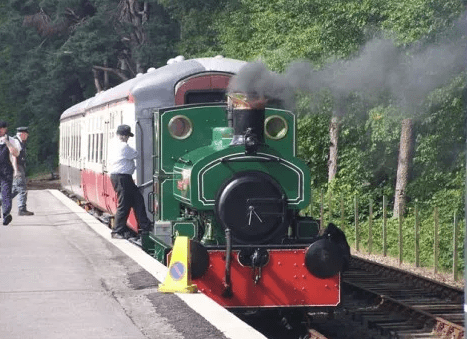
This registered charity (SC027686) started to restore part of the line in 2003, Trains often run Wednesdays, Saturdays & Sundays in July, and Saturdays & Sundays in August. and perhaps Wednesdays in August too if crews can be put together. First train is at 12.00 hrs and every 30 minutes thereafter until last departure at 16.30 hrs. Journey time circa 20 minutes.
Coffee, tea, soft drinks, crisps, biscuits, etc available in the buffet coach and lots of things you didn’t know you needed in the shop – even some “Practical Mechanics” magazines from the 1906s.
Deeside Steam & Vintage Club
The Annual Rally of the Deeside Steam & Vintage Club is held on a Saturday & Sunday in August at Milton of Crathes (adjacent to the Royal Deeside Railway), Crathes, Banchory.
Gates normally open at ~ 10:00 A.M. on both days<
Learney House.
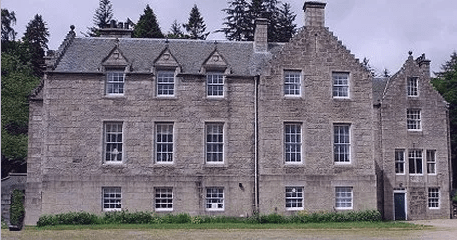
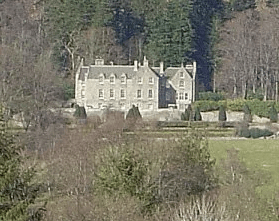
Learney House is situated on the nearly 7,000 acre Learney Estate in beautiful Royal Deeside. Built originally in 1747 as a country mansion with panoramic views over the Dee valley and south Aberdeenshire.
Officially in the Kincardine O’Neil parish, its position is 830 feet above sea-level, on the eastern slope of Learney Hill of (1150ft), 2 miles N by E of the later Torphins railway station. Accidentally burned down in 1838, and then afterwards rebuilt. It is the official seat of Innes of Learney. In 1874 it was listed as providing an annual income of 3264 Pounds
The house is the perfect setting to explore the many and varied activities and tourist attractions in North East Scotland, having been sympathetically and tastefully restored and furnished in a comfortable, traditional country house style, with all the benefits of modern amenities.
Thomas Innes of Learney.
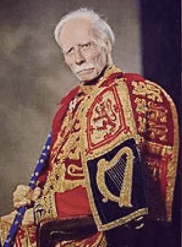
Sir Thomas Innes of Learney, GCVO, WS (1893-1971) was Lord Lyon from 1945 to 1969, after having been Carrick Pursuivant and Albany Herald in the 1930s. He was a very active Lord Lyon, strongly promoting his views of what his office was through his writings and pronouncements in his Court. In 1950, he convinced the Scots Law Times to start publishing the decisions made in Lyon Court. By ruling on uncontested petitions, he was able to expound many of his theories in court but not under review of his superior court, and get them published in the judicial record. His treatise, Scots Heraldry, was first published in 1934 when he was Carrick Pursuivant; then a second, enlarged edition came out in 1956, and it has practically eclipsed earlier works on the subject. Following his retirement as Lord Lyon in 1969, he was appointed Marchmont Herald.
Innes of Learney’s writings contain a number of theories which. at a time when English armorial law had come to dominate even Scottish heraldry, may have seemed quite novel, despite his claims that they were grounded in Scotland’s feudal past. Most notable is the claim that a grant of arms in Scotland confers what he calls “noblesse” and equates with nobility. There are also other claims, such as his right to decide disputes over chiefships of clans or branches of clans, his right to decide disputes of precedence, his right to confer nobility to non-physical persons such as corporations or associations, etc. These rights are still (2007) being exercised by the Court of the Lord Lyon. As a highly qualified jurist, in ‘Scots Heraldry’ and in his revision of Adam’s ‘The Clans, Septs and Regiments of the Scottish Highlands’ as well as in ‘The Tartans of the Clans and Families of Scotland’ he offers ample evidence from ancient legal documents as well as more recent parliament and court decisions to support his position.
Written Works:
Armorial Conveyancing (by Learney as Albany Herald, in: Notes and Queries.1941; 180: 128-133
Adams, Frank, revised by Sir Thomas Innes of Learney, Lord Lyon King of Arms, The Clans, Septs and Regiments of the Scottish Highlands, 4th ed. Edinburgh & London 1952. (First published 1908, 2nd ed. 1924, 3rd ed. 1934) – Important and authoritative additions by Learney as the Lord Lyon King of Arms.
Law of Succession in Ensigns Armorial. Scots Heraldry, W. & A.K. Johnston Limited, Edinburgh & London: 1938. 2nd ed. revised and enlarged, Edinburgh & London 1956. 3rd ed. revised by Malcolm R. Innes of Edingight, Marchmont Herald (his son, later Lord Lyon King of Arms)London & Edinburgh 1978.
The Tartans of the Clans and Families of Scotland, 1st ed. 1938, 2nd ed. 1945, 3rd ed. 1947, 4th ed. 1948, 5th ed. 1950,reprinted 1952, 6th ed. 1958, 7th ed. Edinburgh & London 1964.
Craigmyle House.
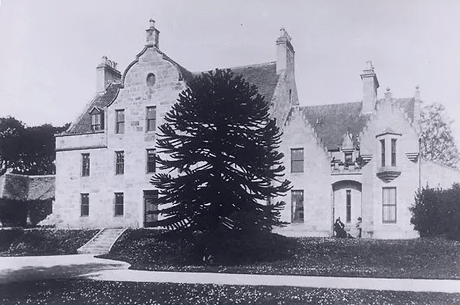
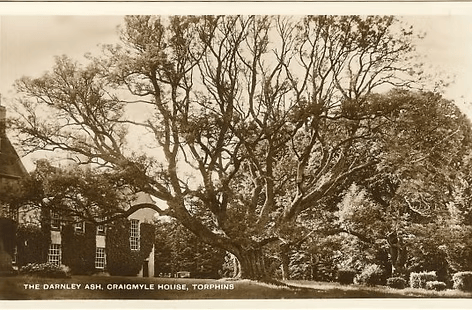
An estate and former mansion in Aberdeenshire, Craigmyle House stood just east of Torphins and 6 miles (10 km) northwest of Banchory. Built in 1676 by a branch of the Burnett family,
it was extended and modernised by architect Sir Robert Lorimer in 1902 for R. P. Robertson of Glasgow.
Sir Robert Stodart Lorimer,(1864 – 1929) was an architect noted for his restoration of castles, and his promotion Arts and Crafts style in Scotland. He was born in Edinburgh, the
son of James Lorimer (1818-90), a Professor of Law, and educated at the Academy and University in the city. He started his career working for Sir Robert Rowand Anderson (1834 – 1921). He began his own practice in 1892 and went on to build or remodel a large number of country houses, castles and several important public buildings. He was the architect of the Scottish War Memorial at Edinburgh Castle and the Thistle Chapel at St. Giles (Edinburgh). Sir Robert Stodart Lorimer lived in Kellie Castle (East Fife), continuing the restoration begun by his father. His elder brother was the artist John Henry Lorimer (1856 – 1936) and his son, Hew (1907-93), became a noted sculptor.
Craigmyle House was later the property of Thomas Shaw, regrettably it was demolished by staged explosion by the army in 1960.
Peel Ring of Lumphanan.
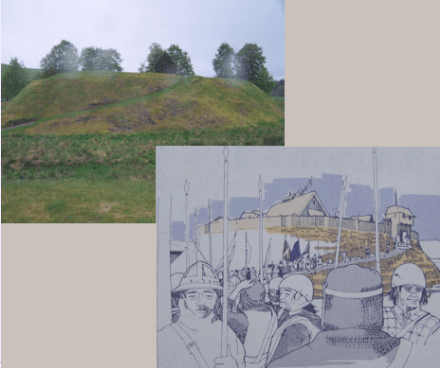
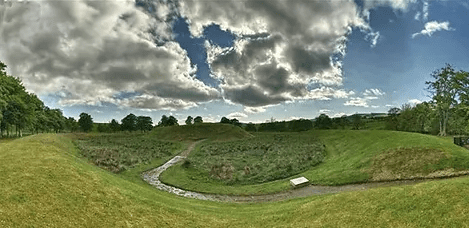
The Peel of Lumphanan, also known as the Peel Ring or Peel Bog of Lumphanan, is a defensive structure dating back to the early 1200s,constructed by the De Lundin family. It lies just outside Lumphanan Village, Aberdeenshire.
The original ramparts may have been of turf rather than stone, and the De Lundin family later adopted the name Durward from their hereditary position of royal ushers or door-wards. Sir John de Melville paid homage to Edward I of England at the peel in 1296.
The peel comprises a mound or motte, surrounded by two concentric ditches separated by a bank. The outer earth bank is about 4 metres (13 ft) high, the inner ditch or moat is 15 metres (49 ft) across, and the central mound measures 37 by 45 metres (121 by 148 ft). The outer ditch was described as shallow in 1960, and is now difficult to discern. On the top of the mound are the remains of a 1-metre (3 ft 3 in) thick wall, and the foundations of former Halton House, measuring around 15 by 4 metres (49 by 13 ft). The entrance was probably located to the west.
Halton House was built in the 15th century by Thomas Charteris of Kinfauns. The circular wall, originally thought to have been the curtain wall of a shell keep, was discovered through excavation in the 1970s to be of 18th-century date.
An earlier motte on this site is thought to have been in existence at the time of the Battle of Lumphanan. This battle was fought nearby in 1057, between King Macbeth and the future King Malcolm III. Macbeth was killed, and Macbeth’s Stone, upon which he is said to have been beheaded, is located 300 metres (980 ft) to the south-west.
Macbeth was a king of the Scots whose rule was marked by efficient government and the promotion of Christianity, but who is best known as the murderer and usurper in William Shakespeare’s tragedy, although in reality, Macbeth was an admired and able monarch.
Mac Bethad mac Findlaich, known in English as Macbeth, was born in around 1005. His father was Finlay, Mormaer of Moray, and his mother may have been Donada, second daughter of Malcolm II. A ‘mormaer’ was literally a high steward of one of the ancient Celtic provinces of Scotland, but in Latin documents the word is usually translated as ‘comes’, which means earl.
In August 1040, he killed the ruling king, Duncan I, in battle near Elgin, Morayshire. Macbeth became king. His marriage to Kenneth III’s granddaughter Gruoch strengthened his claim to the throne. In 1045, Macbeth defeated and killed Duncan I’s father Crinan at Dunkeld.
For 14 years, Macbeth seems to have ruled equably, imposing law and order and encouraging Christianity. In 1050, he is known to have travelled to Rome for a papal jubilee. He was also a brave leader and made successful forays over the border into Northumbria, England.
In 1054, Macbeth was challenged by Siward, Earl of Northumbria, who was attempting to return Duncan’s son Malcolm Canmore, who was his nephew, to the throne. In August 1057, Macbeth was killed at the Battle of Lumphanan in Aberdeenshire by Malcolm Canmore (later Malcolm III).
Cawdor Castle is perhaps best known for its literary connection to William Shakespeare’s tragedy Macbeth, the title character of which was made Thane of Cawdor. However, the story is highly fictionalised, and Cawdor Castle itself was built many years after the events of the play. It is Shakespeare’s shortest tragedy and is believed to have been written sometime between 1603 and 1607. Farther afield, the play mentions Birnam Wood, which lies near Dunkeld, where there are traces of a hill fort on Dunsinane Hill a few kilometres South – South East, a nearby hill to this is still named King’s Seat.
The site is under the guardianship of Historic Scotland, and is protected as a scheduled monument. It is considered to be of national importance as “a good surviving example of an earthwork castle with water-filled outer defences”.
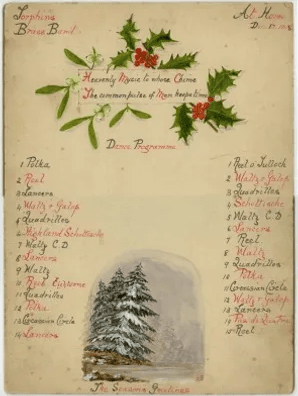
Torphins Brass Band.
Torphins had a brass band in past years.
We do know a few details received from the son of a past resident whose mother (Flora Smith), came from Torphins and surrounding area, and was born at Learney Hall as her father David Smith was the caretaker.
Below is a music list for a dance, we presume held in the Learney Hall, at Christmas 1908. If you have any other information on the Brass Band, or individuals associated with it, please contact the webmaster on admin@torphins.net .
Churches.
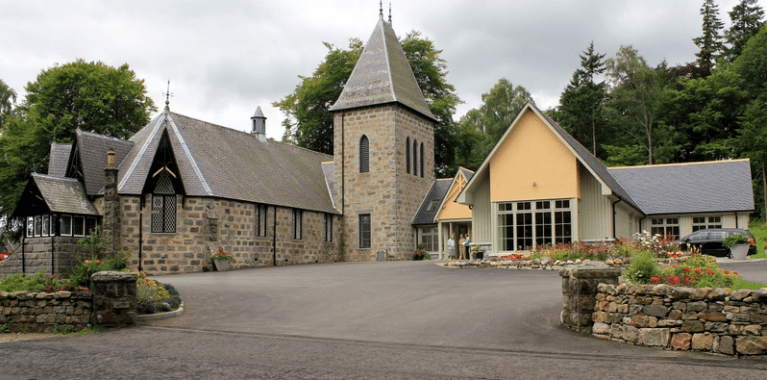
Torphins and Mid Deeside Church Building
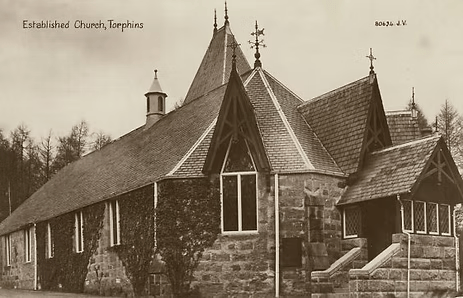
This is an unusual church building with a striking interior, built between 1874 and 1875, designed by J Russel Mackenzie and possible showing influence of Alexander Ellis. It is located at the north end of the village of Torphins, and situated in wooded grounds with car parking all around. The site is raised above the road into Torphins and the manse sits slightly up the hill from the church, to the west. Commonly known as North Church when a former United Free Church in Torphins became South Church (now closed), it is now the only church in the area.
The church is long and low, with a narrow, rectangular nave, an apse at the east end and a tower to the north ,similar in Germanic style to some churches found in parts of Central / Northern Europe in the Mid 19th Century. The roof structure is slated and has a single metal ventilator on the ridge line. Large blocks of coursed granite were used to build the walls, and subsequent pointing has obscured a lot of the stonework.
The east end of the church forms the main focal point, with an apse, entrance porch and striking, tall dormer roofs above windows and entrance. The porch is reached by a stone stair case and has a row of windows and exposed timber in the gable. This leads into the apse, which forms a vestibule area before entry into the nave of the church. The apse has tall windows, necessitating tall, slender dormers, which are slated and have exposed timber.
The side elevations are long and low and have rectangular windows, which reach the wallhead. All the windows of the church have lattice glazing, apart from a single stained glass window in the south elevation. The junction of the nave and apse has a small, stepped buttress. The north elevation is dominated by a tall, rectangular tower. It has rectangular windows at ground level and pointed-arch, louvered belfry openings above. The piended roof shows Germanic influences, and is topped by a weather vane. The low, west gable features a three-light lancet window with stained glass.
The interior is dominated (as intended) by its imposing scissor-beam pine roof structure, which shows the influence of architect Alexander Ellis. The nave was designed with low walls and a tall roof to emphasise the internal roof structure. This creates a light and spacious space, heightened by the large dormer windows in the apse end of the church. The walls are painted white and have a number of stone memorials and locally-made wall hangings. The floors are covered by blue carpet.
The sanctuary at the west end of the church, is raised from the nave by several steps. A large organ occupies the north-west corner of the interior. The sanctuary has a carved wooden communion table and a fairly tall pupit, reached by wooden steps. The simple pews of the nave are in pine.
An extension to the church has recently been opened, giving a valuable community resource for Church and village functions.
South Church Building History and Description
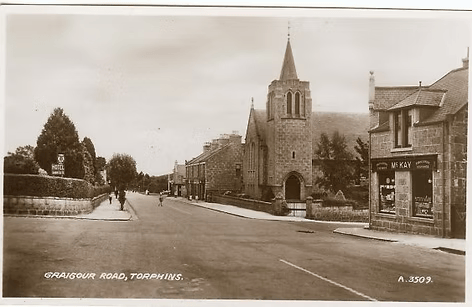
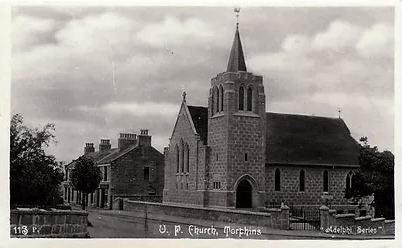
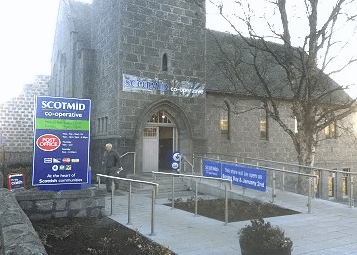
This former church stands in the heart of Torphins village, along the main road. It was built as a United Free Church at the start of the 20th century and stands in fairly small grounds with mature gardens to the north-west. The congregation later united with Church of Scotland, in 1929, and the church was re-named South Church. It was latterly in use as a church hall and Auction Room, but had generally lain redundant for some time, then used for many years as “Mother Hubbard” pine furniture retail store. “Mother Hubbard” closed in summer 2011, and the building reopening in November 2011 as a Co-op “Morning Noon and Night” Mini Market, whose existing smaller shop in the village it replaced.
The church was built in granite, with small stone pieces set between large blocks (known as pinning). The roof of the nave is slate
The north-east elevation, fronting the main road, consists of the nave’s gable end and a fairly tall square tower. The nave has a three-light window made up of pointed-arch (lancet) openings with simple tracery and hoodmoulds. There are small panes of square glass, some coloured. Below the main window are pairs of small lancet windows. A group of three lancet vent openings are located in the gablehead. The corners of the gable have buttresses, which are built into the skews. A tall stone cross finial is mounted on the apex of the gable. The tower is fairly simple, with a pointed-arch entrance doorway to the north-west and small rectangular windows at ground level. There are small stair lights higher up in the structure and a belfry stage has large pointed-arch openings with hoodmoulds. At the top is a simple battlemented parapet. A slender (spike) spire rises from the top of the tower and is tiled (rather than slated)
The side elevations of the church are relatively simple, with tall and narrow lancet windows equally spaced along the length. The southern end of the building is taller, due to sloping ground, allowing for a series of rooms under the nave. These are lit by rectangular windows at ground level.
The south-west gable of the church has a tall apse, centrally placed in the gable. It has lancet windows at nave level and rectangular windows below, in the basement level. There is a small attachment at the south corner, which has a small door and rectangular windows. Above is a tall chimney, which reaches the level of the nave roof apex.
The original church interior fittings and furnishings have long since been removed when the building was originally redeveloped, but retains the original visible wood roof beams and remaining Stained Glass windows.
Coopers Lane.
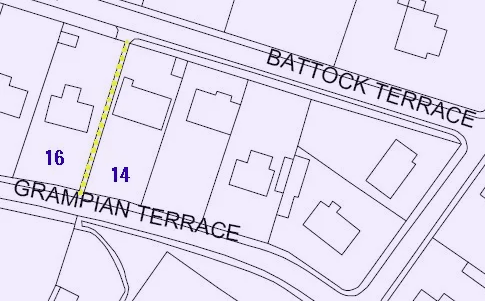
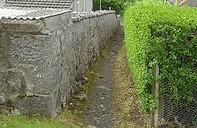
Coopers lane, running up between no’s 14 and no’s 16 Grampian Terrace to Battock terrace. This lane was named from its use in the late 19th and early 20th Century by the local baker, Mr. Cooper, to take his cart horse up and down to the field, which at that time lay at the rear of the houses on the site.
You will notice the photographs (May 2009) show a badly washed out footpath together with undermining of the wall foundations. This was caused by severe rainwater runoff from Battock Terrace. The pavement, drainage and kerb at the upper end of the lane have been reworked in late 2008 to prevent this happening again. It is hoped that funds will be made available to Torphins Community Council from Aberdeenshire Council, to repair the pathway in summer 2009.